Models
End-to-end blueprints of working solutions—covering data, workflows, and interfaces. Use them as-is, extend them, or run them through AI to generate new versions. Models give you a reproducible starting point that ships apps, sites, and APIs in minutes.

US Population by Age Group and State
Explore population distribution across U.S. states with age-group breakdowns for fast demographic insights.
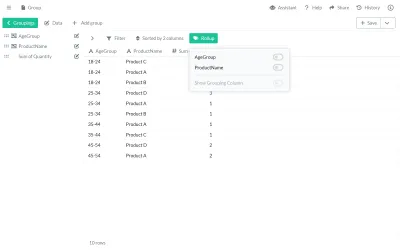
Most Sold Products per Age Group
Identify top-selling products segmented by age groups to reveal buying patterns and target markets.
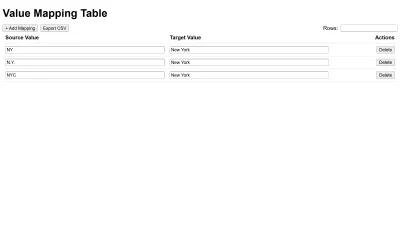
Value Mapping Table
Standardize inconsistent values by mapping source inputs to unified outputs for cleaner, structured data.

Bar Chart with Negative Values
Visualize positive vs. negative contributions with a diverging bar chart that highlights contrast clearly.
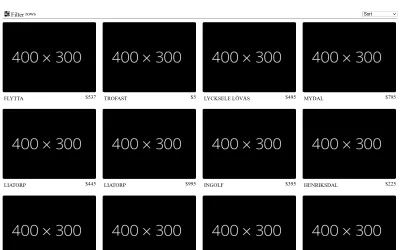
Product List with Sidebar Filter
Browse products with instant filtering, sorting and infinite scroll—UI-ready and production-fast.
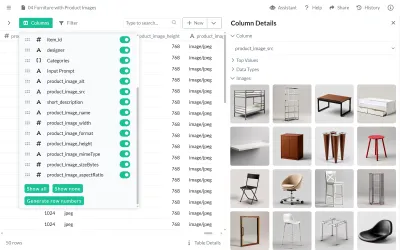
AI Product Image Generator
Start with a product table without images. End with the same table filled with AI-generated product photos (image_url) — ready for catalogs and UI.
Product Catalog Operations Proof Model
A reusable Datavju Model that starts with public catalog data, adds inventory and pricing review rows, then builds a Transform-backed review queue and row-inspection workspace.

Hero with Background Image and Text in Front
An atomic Datavju Model that packages a hero section as inspectable structured state, ready to load, inspect, and adapt.
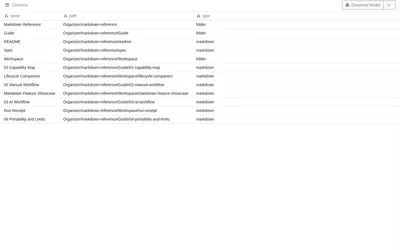
Markdown Reference
Use a static Guide, mutable Workspace, and two purpose-built Agents to run and verify a complete Markdown lifecycle: create, read, full-source update, persisted verification, exact deletion, reset, and idempotent rerun.
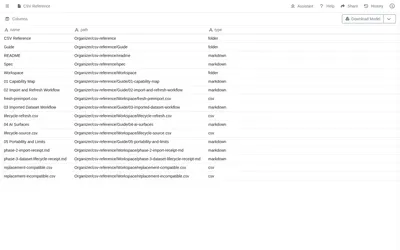
CSV Reference
CSV Reference provides a clear, reusable guide to working with CSV data in a Datavju Model. Use it to understand expected data structure, support consistent validation, and prepare factual reference content for publication.
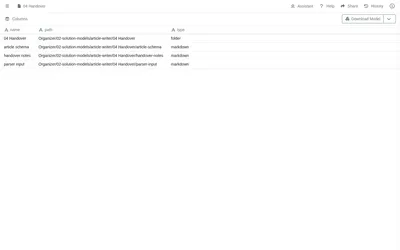
Article Writer
Article Writer gives teams a focused Model for shaping article content from an initial brief through structured review. Use it to organize writing inputs, validate that the draft aligns with the intended angle, and prepare content for publication workflows without starting from a blank page.
View Reference
Use a deterministic source Dataset and saved View to inspect structured state, apply validated filters, sorts, search, visibility, and paging, and verify the exact result.
Transform Reference
A portable reference Model for deterministic Transform pipelines: normalize values, calculate fields, extract dates, filter rows, aggregate by category, and preserve identity behavior.
Viz Capability Reference
Use this practical reference to review Viz capabilities in a runnable Model and preserve the delivered Viz Capability Reference Builder User Agent through the public snapshot.
Product Catalog Exception Queue
A portable Model that checks for missing categories, missing images, invalid prices, and inactive products with stock, then presents the exceptions in a saved review View.
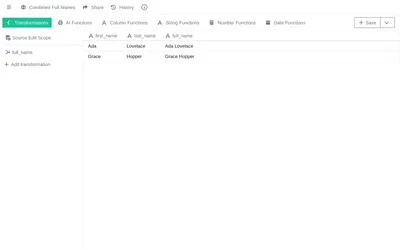
Combine First and Last Name
Turn separate first- and last-name CSV columns into one full-name column. Choose the separator, output name, and whether to keep the source columns, then inspect, reuse, or download the result.
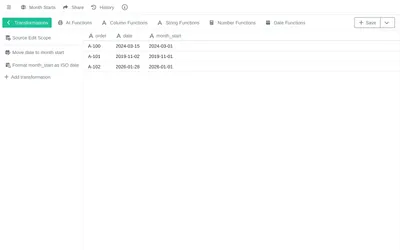
Truncate Dates to Month Start
Transforms ISO dates in orders.csv to the first day of their month in a new month_start column, retaining the original data and direct source lineage.
Basket Category Summary
Turn a 12-category basket summary into a concise public View that highlights leading categories, preserves Norwegian characters, and retains direct lineage to the source CSV.
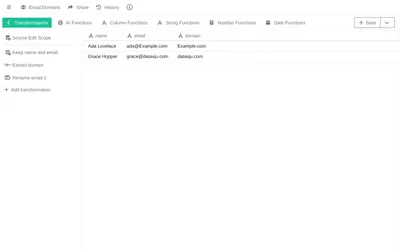
Extract Email Domain
Extract email domains from contacts.csv into a new domain column while retaining name and email. Preserve case by default, optionally lowercase domains, and reuse the existing Transform across runs.
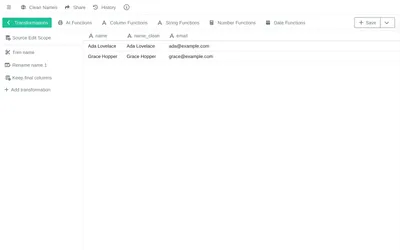
Trim Whitespace from Names
Trim leading and trailing whitespace from CSV names while preserving original columns and internal spacing. The existing Transform can be updated to collapse repeated spaces, reused on reruns, and cleanly reset.
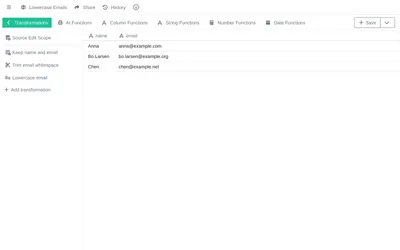
Lowercase Email Addresses
Clean email addresses in a CSV by trimming surrounding whitespace and converting them to lowercase in place, while preserving the original columns and source lineage.
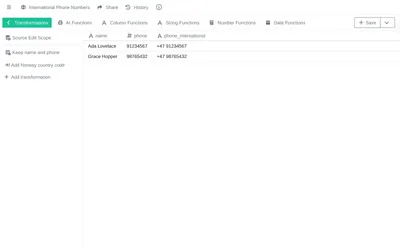
Add Country Code to Phone Numbers
Adds +47 to phone numbers in an uploaded CSV, preserves the source columns, and creates a reusable phone_international column for inspection and download.
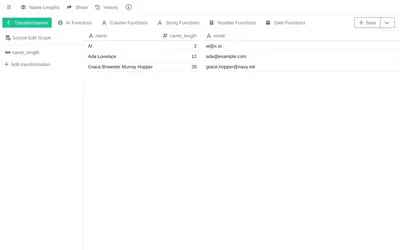
Count Name Characters
Count characters in contact names from a CSV while retaining the original data. Reuse, update, reset, inspect, and download the structured result.
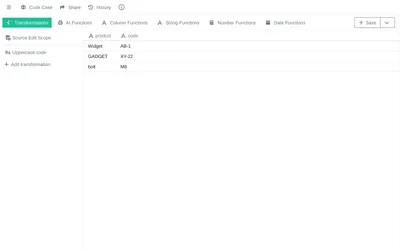
Uppercase Product Codes
Uppercase product codes in place while preserving all other CSV data. Inspect, reuse, and download the transformed result, update it to lowercase product names, or reset and recreate a clean default transform.
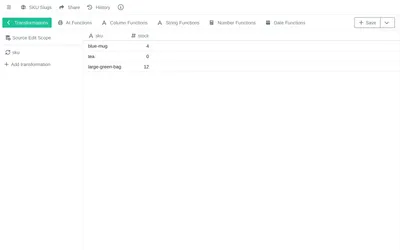
Replace Spaces in SKU Names
Convert space-separated SKU names in an uploaded CSV into hyphenated slugs in place, preserving every other column. The separator can be changed to underscores, and the structured transform can be reset and recreated cleanly.
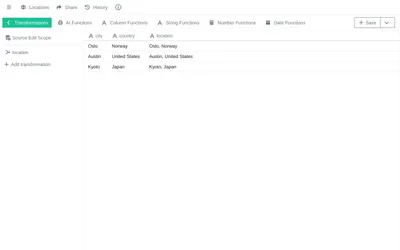
Combine City and Country
Create a reusable Locations transform that combines city and country into a location column while retaining the source fields and CSV lineage.
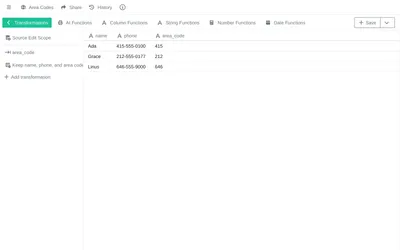
Extract Area Code
Creates a reusable Area Codes Transform from contacts.csv, retaining name and phone while adding the first three phone-number characters as area_code. Supports an in-place line_number update and a clean reset.
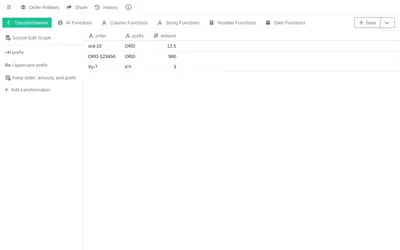
Extract Order Prefix
Create an uppercase three-character order prefix column while retaining the original CSV fields and direct source lineage. Results remain inspectable, reusable, and downloadable.
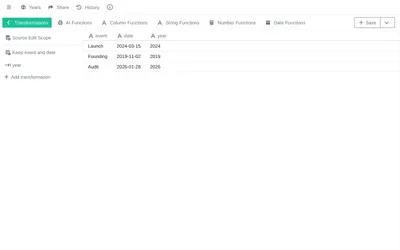
Extract Year from Dates
Extracts four-digit years from ISO dates in a CSV while retaining source columns. The existing transform can be updated to return year-month values, reset, and recreated without duplicates.
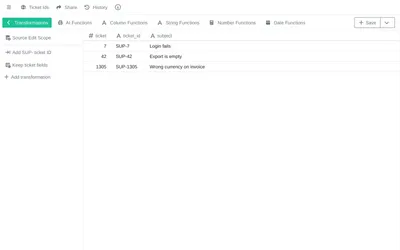
Prefix Ticket Numbers with Department
Create reusable ticket IDs by prefixing CSV ticket numbers with SUP-. Retain the original ticket and subject columns, inspect and download the result, and update the prefix to OPS- when needed.
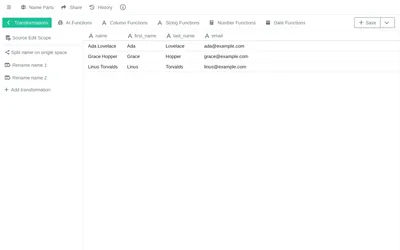
Split Full Name into First and Last Name
Split a CSV `name` field into reusable first- and last-name columns while retaining the original data and direct source lineage.
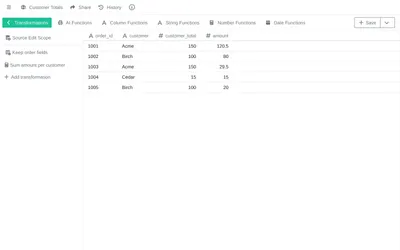
Total Spend per Customer from a JSON Export
Import a flat JSON order export and append each customer’s total spend to every matching order row. Retain the original columns, preserve source lineage, and reuse the structured transform across runs.
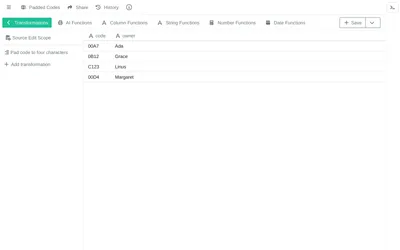
Pad Locker Codes to Four Characters
Standardizes locker codes by adding leading zeros while retaining owners and direct CSV lineage. Supports in-place changes, reset, and clean reuse of one Padded Codes Transform.
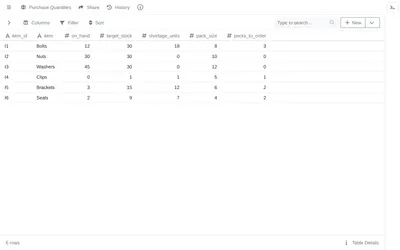
Inventory Order Packs
Turns stock shortages into whole supplier pack orders from inventory.csv, keeps zero-shortage items at zero, and provides a downloadable purchasing view with reusable Run, Change, and Reset lifecycles.
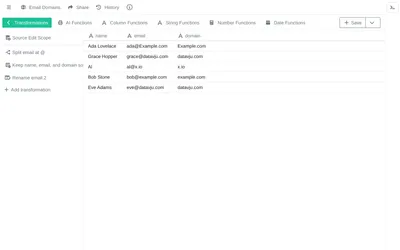
Contacts per Email Domain
Extract email domains from a contacts CSV and count contacts per distinct domain, with optional lowercase normalization before grouping.
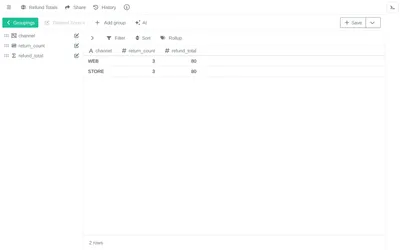
Refunds by Sales Channel
Analyze refunds from returns.csv by normalized sales channel, with reusable Run, Change, and Reset workflows, saved grouped results, and a Markdown summary of six returns and 160 in refunds.
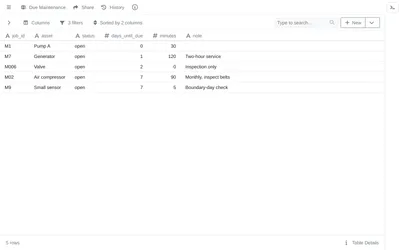
Maintenance Due Window
A saved maintenance work window from jobs.csv. Run shows five open jobs due in zero to seven days; Change includes overdue open jobs; Reset removes the generated View; final Run restores the original ordered 245-minute schedule.
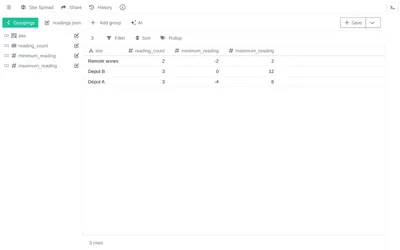
Inspection Reading Spread
Summarizes instrument readings by site with count, minimum, and maximum values, and can add the arithmetic mean without changing the grouping or source data.
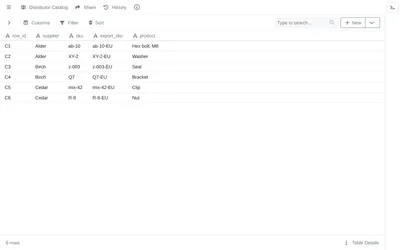
Supplier Catalog Delivery
Cleans supplier SKU whitespace and creates destination-specific export codes from catalog.csv in a single Transform and downloadable View, with reusable Run, suffix-only Change, and source-preserving Reset lifecycles.

Regional Order Status
A reusable regional order-status Model with source Data and Run, Change, and Reset Agents for creating, regrouping, removing, and cleanly recreating an interactive Page and Bar Viz.
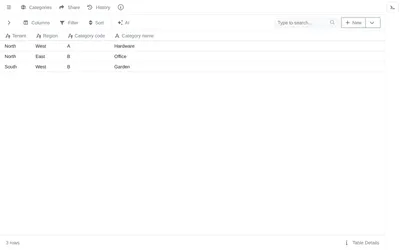
Categories and Products reference
A reusable categories-and-products model covering publication, independent import, definitions, keys, relationships, saved-Agent lifecycle, and external-AI Run, Change, and Reset through MCP.
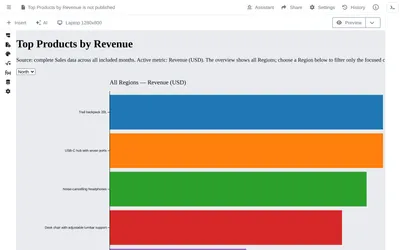
Top Products by Revenue
Rank products by summed Revenue across all Regions and within a selected Region, then switch the same analysis to Units. Includes inspectable aggregation, definitions, reusable lifecycle agents, stable ordering, and source-preserving reset behavior.
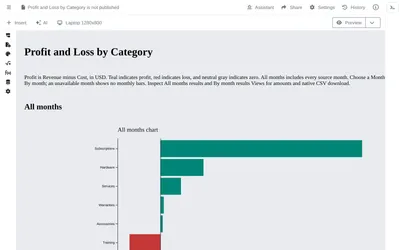
Profit and Loss by Category
Analyze category profitability across all months or a selected month. Totals, zero-profit categories, loss/profit charts and native CSV Views are paired with repeatable Run, Change and Reset lifecycle assets.
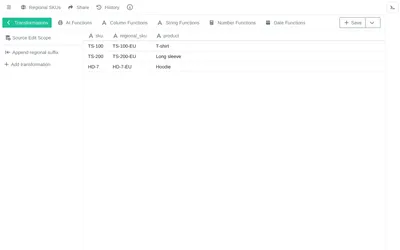
Append Region Suffix to SKUs
Create reusable regional SKU data from a CSV. One structured Transform retains source columns, adds regional_sku, supports in-place suffix changes, resets cleanly, and includes portable schema and suffix Definitions.
Channel Assortment Reconciliation
Supplier Revision Destination Review
Shipment Load Share
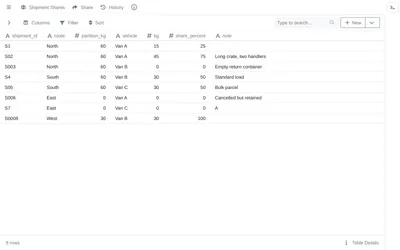
Keep all eight shipments visible with numeric route totals and weight shares. Switch to vehicle-load comparisons, reuse results without duplicates, or reset to restore the original route-based setup.
Worklog Dual Breakdown
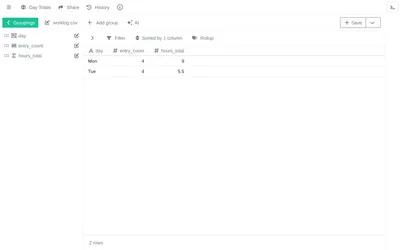
Summarize one worklog independently by project and day, then switch only allocation to people. Reusable Run, Change, and Reset Agents preserve the source and keep the two branches separate.

Service Ticket Resolution Mix
Compare synthetic ticket outcomes for four teams across January–March 2026. Overall and selected-month stacked charts, inspectable results and CSV downloads support reusable percentage and count presentations.
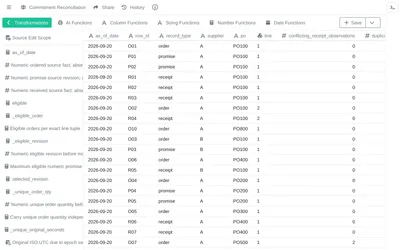
Supplier Commitment Evidence Review
Review supplier commitments at an explicit cutoff, distinguish open from overdue quantities, and preserve order, promise and receipt history. Ambiguous evidence is held for reconciliation rather than treated as a shortage or late delivery.
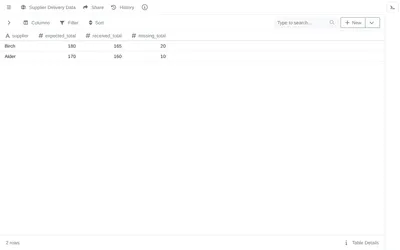
Supplier Delivery Report